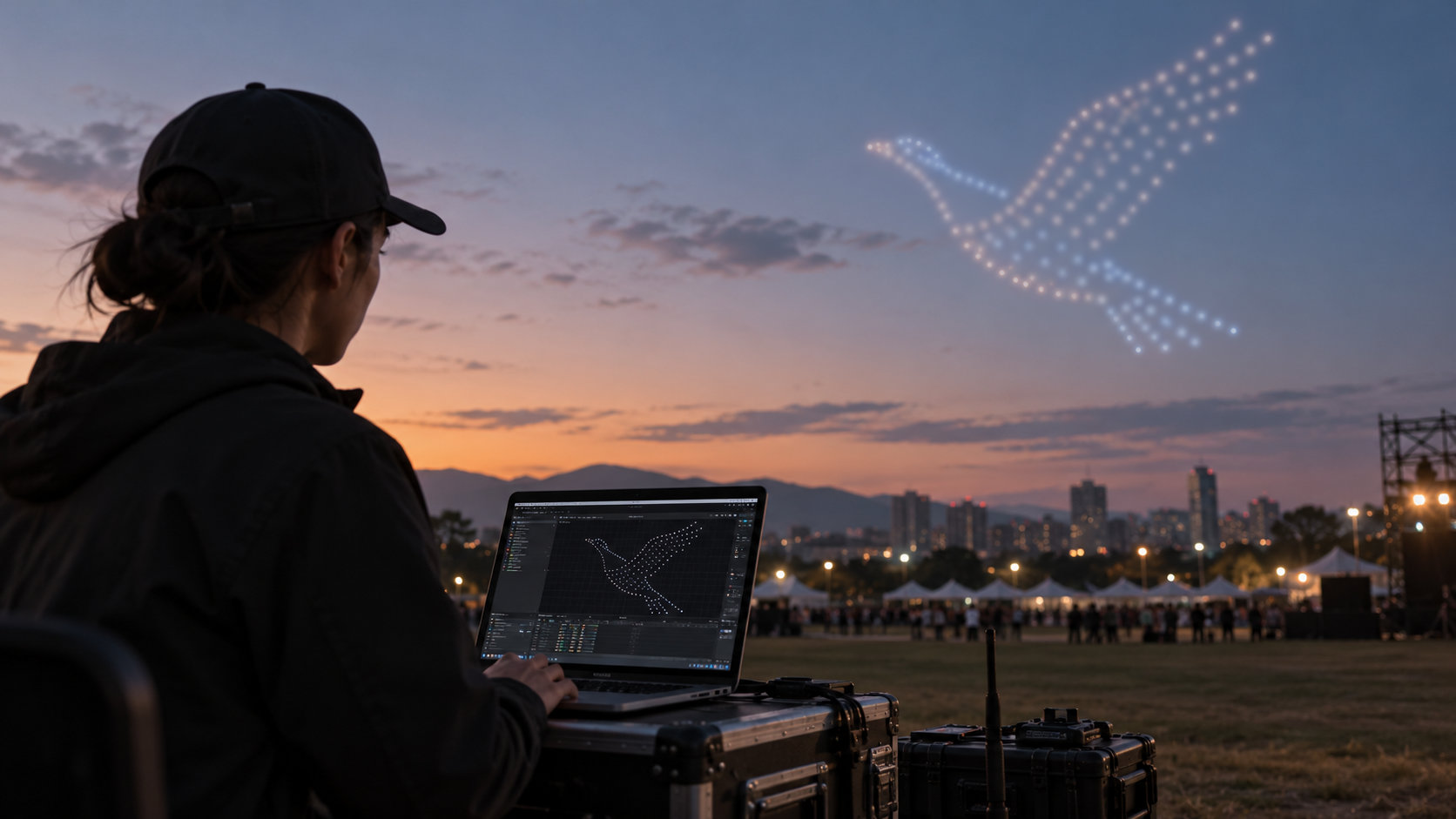
Designing and choreographing a show is a commercial process, not a brief flash of production, nor an endless back-and-forth art project. However, drone operators, event organisers and end customers have their own processes, ambitions and sometimes even rapidly evolving outside conditions. Drawing on my experience delivering over 200 shows, I’ll share my drone show animation workflow and the common variations.
The perfect drone show project
More often than not, an animation project runs along a very smooth and predictable path:
- I get a brief with all the essentials – fleet size, duration, deadline, scene list, logo references.
- I prepare the scene designs (usually 8-15), with possible alternatives, and send them as drone formation images.
- The drone operator and the client give feedback and I deliver revised designs.
- After sign-off, I create the animation with lights and deliver a video preview.
- With final revision of timings, I make pre-flight checks and deliver flight-ready files.
With a process like this, a delivery time of 1–2 weeks is very feasible.There are a few points of potential delays, like extra revision rounds and scene changes, but nothing usually disrupts the actual flow.
Drone show animation in a rush
We don’t always have two weeks, or even one. Usual rush jobs need either designs or a full show in 2–3 days. I can normally accommodate a quick timeline, especially for reasonably-sized fleets, but the process will become tighter. The designs will need to be approved quickly, and major modifications to the final choreography may be limited, but the delivery will be quick without undue compromises on quality.
Need a show for tomorrow?
Call me. I have delivered shows under 24 hours, but they are special cases and very much subject to availability. These are cases of extreme compromise, but with a little planning, a lot is possible. My approach is to take a serious look at the requirements and discuss realistic options to ensure that a show will be ready to fly on time.
Alternative or optional scene designs
Not sure about the final order of scenes, or need a few options to choose from? No problem. It is common to have a few scenes where it’s great to have options. Maybe the client is not sure if they want a rose or a diamond ring, perhaps they have a few logo versions that need to be approved by the branding team. I am happy to deliver alternatives.
I do sometimes create alternatives even without asking. For example, for client logos, I might suggest a few versions of how they would translate into drone formations.
The order of the scenes is in no way fixed until the animation stage, so feel free to juggle them around. I will confirm the final order before beginning with the choreography work. It is actually a very good idea to do a final rethink at the draft stage. While scene order change is possible later in the process, it may result in other compromises, like longer transition and delivery times, so I encourage you to keep the order fixed after the scenes are final. I do design the scenes to fit the original script to enable smooth and fast transitions, so for the best results, figure out the order before scene design.
Show area changes
This is not an issue for all drone show systems and workflows. For some systems, I deliver only the show part and the system handles takeoff, landing and show positioning. Changing the direction or landing formation will not affect my work at all.
For systems where I create the paths from either ground or from lift-off hover, I need to know the landing area (and possibly the formation), as well as show location and direction. Orientation and the ground formation can be changed, and sometimes do, even in the final hour before flight. After experiencing a few panic-stricken last-minute revisions, I nowadays design all my projects in a way that these can be modified quickly and easily.
I have provided drone choreographies for shows where there was no possibility to survey the location beforehand, so I’ve prepared a few different alternatives based on good guesses, and the operator has had them ready for when they arrive at the scene.
No script? Need ideas?
Sure, let’s talk. I’m happy to discuss some ideas, provide reference scenes or develop the script from just the show theme. Have a wedding, graduation or a Christmas show coming, or something more esoteric – a stage magic performance or the opening of a new highway? I will get the script for you.
A show doesn’t always need a story. For a business event, using logos, product shapes and brand messages is usually well-received. Sometimes, a fully abstract show is the best fit for the event. For a wedding, you can’t go wrong with a flood of symbols – hearts, love, doves, sparkles and perhaps some appropriate ceremonial icons.
Have a client who wants to bounce some (or a lot of) ideas?
Set up a meeting. I have worked 20 years in the advertising industry – I get along with clients with creative ambitions. I’ll be able to guide them through options, limitations and possibilities to keep everyone happy. Many do get worried or indecisive with creative processes, so I can help in establishing the confidence that the project will go smoothly and ensure the result is at least as good as they want it to be.
Synchronising music, lights, dancers, band…
Synchronisation is the key to a great performance. That’s why I want to adapt to whatever makes the whole project run the smoothest. Schedule permitting, there are three options:
- I get a time-coded script or a soundtrack and sync the show.
- I provide the show video and other elements are synced to it.
- I provide a draft video without all the light effects to demonstrate the rough timeline, and once the soundtrack and/or time-coded script is finalised, I fine-tune the show.
Whichever process works for the project in hand, it will work for me. These do affect delivery times, though, so agreeing on the process beforehand ensures a smooth project.
There is also the option 4: bounce the show, music, script, lights back and forth hoping it will converge into a synced whole. I don’t recommend this. No-one is happy to pay for extra revision rounds just because of an unclear process.
What about pencil sketches, motion mockups, 3D models, timing sheets?
If you have the extra budget and the time for them, sure, I’ll deliver. But after years of delivering drone show designs and animations, I have failed to see the benefit except for special cases. These can create a sense of more careful planning, but they will usually not create better shows.
When I have created shows for other media (like a TV commercial), we have had motion mockups with the environment and the other on-screen elements in place. These have added value to enable planning of camera angles, safety margins or dancers’ choreography, but for 99% of shows, it would just be an extra step.
Feedback, revisions and reviews
It’s not my show. It’s not the drone show company’s show. It’s the client’s show. I put great effort into each show to make it as impressive as possible and appropriate for the event. I also suggest and propose design choices or new considerations to scripts when it’s called for. However, even with my creative input, the final decision is not mine. Many of my clients trust my judgement, but I’m happy to go with the client’s creative direction.
The world is a large place, visual culture and aesthetics vary a lot. The client usually knows their audience and the event mood the best. My goal is not to create the show for myself, but for the audience.
Want to work with me?
Drop me a line on WhatsApp or email. Let’s set up a workflow that works for you.
Need a designer for your drone show?
Send me a brief and let’s get the project done. You can email me at teemu.eskola@gmail.com or WhatsApp at: +358400759676
Or send me a message on my contact page.
