Sure, a great drone show design is dazzling, elegant and powerful. This is what your client is paying for. The problem with these adjectives is that they are subjective. You have a thousand people in the audience so you have a thousand opinions. A senior designer delivers on these ten times out of ten.
In a fast-paced environment and with a growing business, the best design is the one that is:
on time, within budget and with zero hassle.
Things move around – the client is indecisive, location has surprises, the soundtrack guy is leaving for a vacation, drones malfunction and everyone wants to cut costs. The last thing you want is a designer who needs handholding, is unresponsive or can’t get over their own ego.
The best drone show designs look great, allow for flexibility and get done with the minimum of stress. But what makes a show design look great?
Making the fleet size worth it
Small fleet sizes require a different design perspective than large ones. Making a logo or a landmark work with just 50 or 100 drones calls for extraordinary skill that is rarely present in any other art form. I see this analogous to pixel graphic designs from the early ages of computer games. But even the smallest Commodore 64 sprite had 8×8 pixels. That’s 64 coloured dots – more than some drone shows.
Larger fleets have different challenges. What do 1000 drones achieve that 900 or 800 can’t? That’s a delicate question when the client starts asking value for money. Even the last 100 drones should do more than just add detail. Should they be used for additional effects, for text, little symbols or speed lines? Perhaps they can be left lingering dark for a surprise change or a transition feature?
Clarity, angles, scale
Drone show designs must consider the physical space. This is not just landing areas, show areas and obstacles. The audience is not a single viewpoint, but a mass of people spread sideways and in depth.
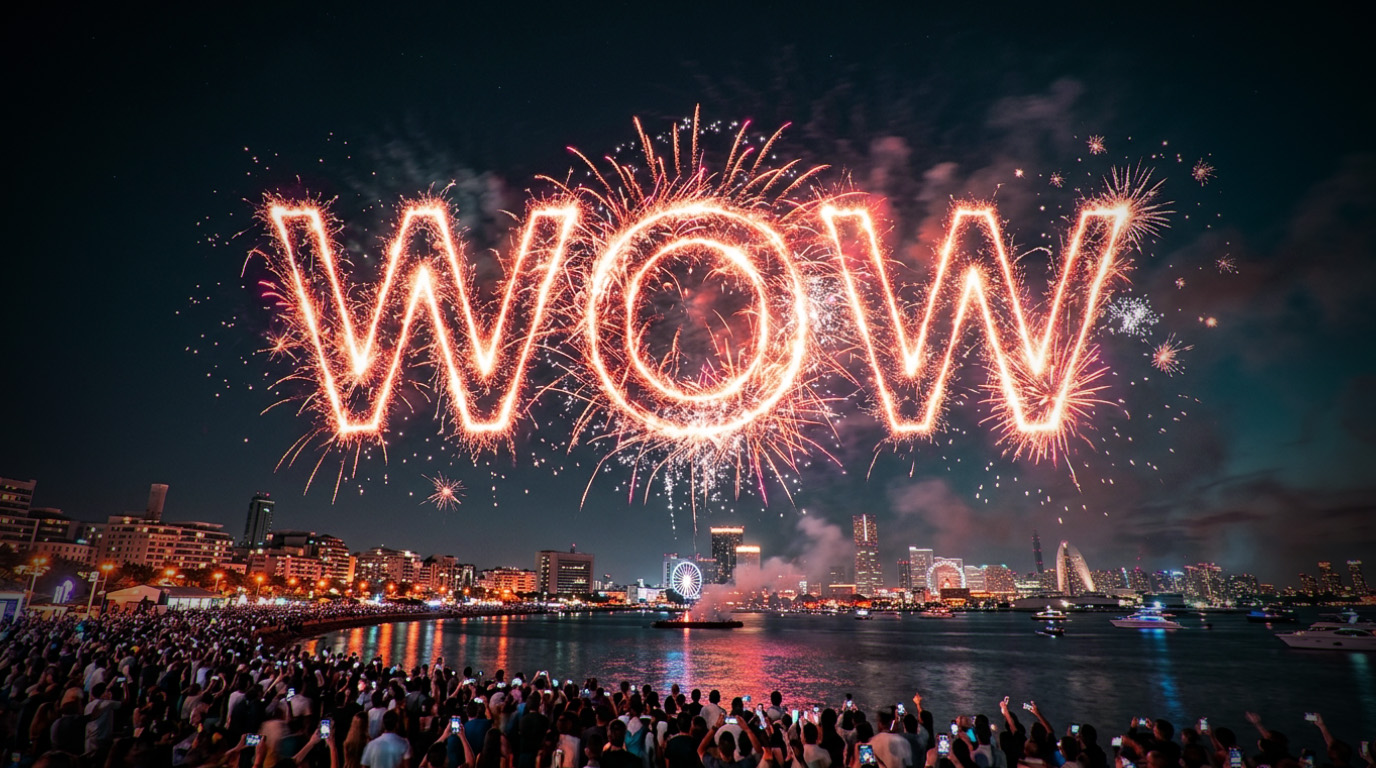
Clarity is essential – texts, logos, products and landmarks must be instantly readable and recognisable. We want the audience go “WOW”, not “WHAT?” Drawing shapes requires careful consideration on where dense packing is needed, where sparser is better. Filling surfaces looks pretty, but takes a lot of drones and obscures detail. Brand-specific, numerically accurate colors may look good on screen, but be muddled in actual drone performance.
The audience is often in one direction to the show, but it is not a straight line. A stadium of people looking at a drone show may have 30° variation in viewing angle. A 3D drone formation with parts occluded will look quite different to viewers on opposite sides of the audience. In some cases, the audience is spread 360 degrees – and for a promotion show in the middle of a city, the show will be viewed from all angles.
Story and pacing
Every show tells a story. Or at least should tell a story. For a 12-minute show with 15-16 scenes, there is potential to go full Aristotelian with the story. Start with an opening, go for drama, ease a bit, hit with a grand finale and land on a happy note.
The choreography of a drone show depends on pacing. A show that is constant in pacing gets boring. It’s like a movie that advances the same speed throughout. Any story needs to breathe. Complex motion paired with stills, fast changes with peaceful ones, flowing colours and abrupt changes. Synced with the theme and the soundtrack, a well-paced show trumps a dragging pacing even if it has nicer individual scene designs.
Drone shows have a lot of intermixed parameters that set boundaries to the pacing. Larger fleets are slower: transitioning from one scene to another with 100 drones happens in seconds. With 3000 drones the audience will be waiting for quite a while. This brings us to an often overlooked point:
Entertaining transitions
We’ve all seen drone shows where the scenes transition with just random blinking. That’s so 2018. A significant portion of the drones’ flight time is spent moving from one image to another. Transitions should be designed, not just tolerated.
I create exceptionally fast transitions (I won’t tell you how I do it), but still I strive to make every flight second count. Great transitions contribute to the story, keep the audience engaged and build anticipation. And transitions need pacing too – sometimes a random sparkling effect is just the right thing to have. Just not always.
Handcrafted designs and effects
Stock images and preset effects are fun for the first few shows. But their value goes down pretty fast. I have worked for 20 years in advertising and I’ve seen the same effect in all productions. You can create cheap productions fast with stock footage, canned music and cliché copy, but they will never hold a candle to real designs.
Drone shows are not cheap, so their design and animation should stand up to the premium value of the production. Naturally budgets change, and some situations call for a project where every cost is cut. A senior designer can adjust the design work based on the budget and deliver quick designs when needed. And if the show is tomorrow, the only goal is that the show is ready before flight.
Process and communication
For many a designer, things like process and project management are the most boring part of the job. With my experience, I’m confident in saying that without a solid process, things get really interesting real fast. Unfortunately, it’s rarely the kind of interesting that is fun, productive or smart.
I have worked for over 25 years in creative industries, from ad agencies to digital production shops to drone show design. I’ve never missed a deadline. This is possible only by being interested in the process – knowing what is happening and when. Most drone choreography projects flow pretty nicely from drafts to designs, from motion to lights and final delivery, but every now and then something happens. With a solid process and active communication, the surprises do not escalate and the project can be returned to its nice and boring timeline: brief > design > revision > delivery.
Want a great drone show design with an uneventful process?
Drop me a line on WhatsApp or email. Find the details on my contact page.