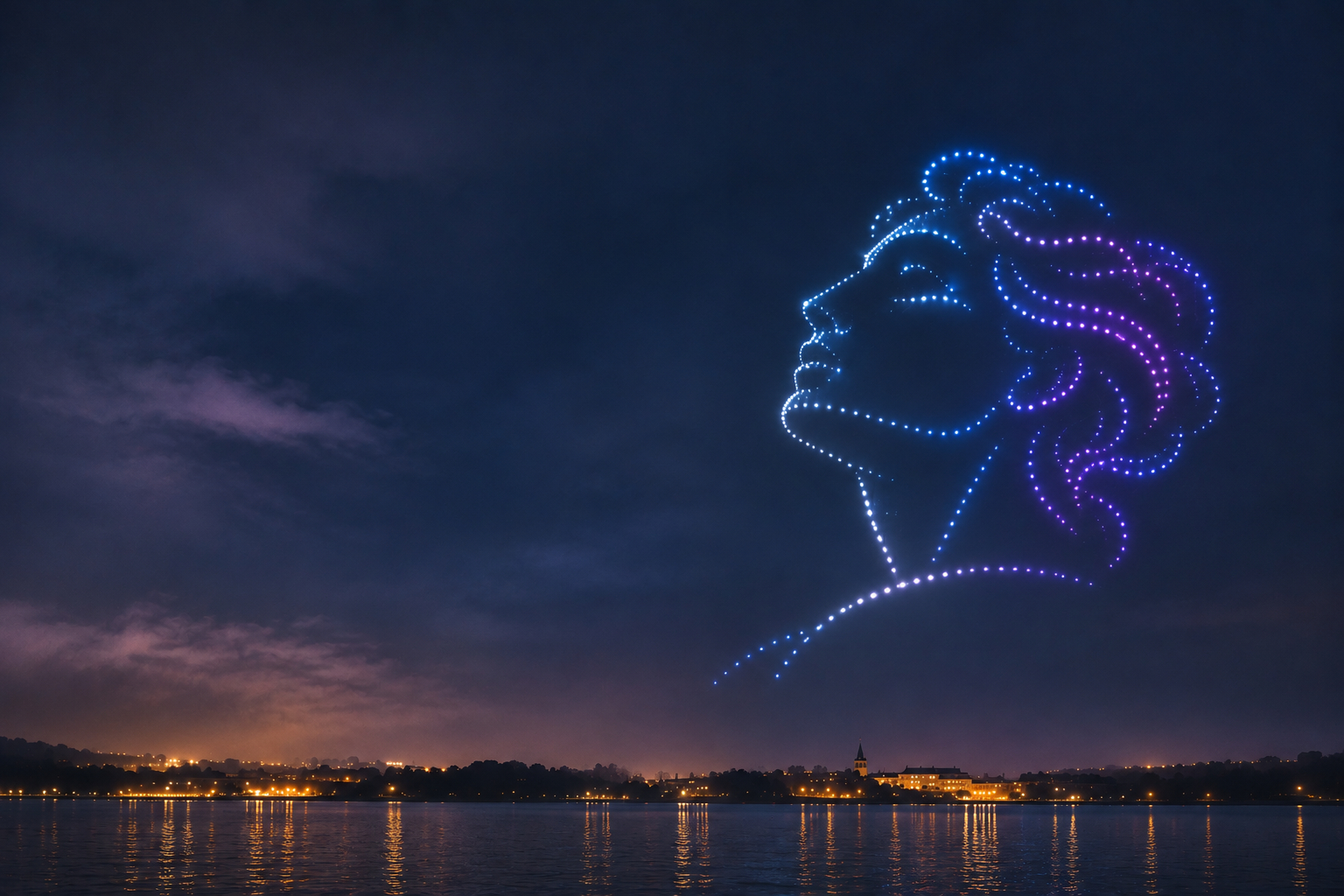
Drone shows are entertainment, sometimes advertising or even propaganda. But are drone shows art? With a background in art history and literature, I might argue this point for hours, even with myself. Luckily, my advertising agency background stands up, tells me to shut up and get on with the designs.
Art or entertainment, I’ll argue that drone shows have their own visual language. One that borrows from the visual arts, movies, animation and even from music and literature. It’s a comparatively young craft, but with its unique constraints and medium, I think it deserves recognition as a separate art form from 3D animations.
Expression, mimicry or rhetoric?
With a young craft, it would be presumptuous to start discussing styles or schools of drone show design. There are some stylistic decisions, each designer has their own voice and even the different design softwares seem to affect style, but I think it’ll still be quite a few years before we can start categorising drone shows to different movements, like in the visual arts.
However, I’d like to discuss the motivation of drone show design. A lot of art is – especially in day-to-day conversations – classified as expression. An artist has “something to say”, and their art is how they say it. Personally, I work on commissions, and there is always a drone show company who needs a show for their client. The show is not an expression of my innermost feelings or my manifesto.
On the other hand, drone shows appear to do a lot of mimicry or mirroring of the real world – objects, products, persons, company logos. We could hardly talk about a realistic art, unless a show was to mirror constellations or vintage LED screens. But do drone shows mimic paintings, drawings or cartoons? I agree that sometimes I borrow from different drawing styles, but if I’m to discuss the visual language of drone shows, I can’t just rely on my own process.
The motivation I can honestly stand behind is one of rhetoric. The same way as James Phelan views narratives as rhetorical acts, I propose that drone shows can be seen similarly: “somebody telling somebody else on some occasion and for some purpose(s)” (Phelan 2007). The operative parts are:
- Drone show has a “speaker” – the event organiser, the drone operator, or ultimately the drone show designer
- Drone show has an audience. Unlike literature, a drone show is pretty much guaranteed viewers.
- An occasion for the act. Again, unlike many art forms, a drone show is defined by its temporal nature.
- Drone show has a purpose. It might be advertising, entertaining, or celebrating. A drone show is always born from a need, it has a purpose. Looking at shows, I’m bound to think that sometimes the designers might forget what the purpose is, but the ultimate payer of the show will not.
Not every drone show needs a plot
A plot in literature is quite a bit more defined than in day-to-day discussions. For simplicity’s sake, as Rimmon-Kenan defines it, a plot is a series of causality-bound events. Plot is the forward-pressing motion of a novel or a film. Does a drone show need one?
I would argue that a good drone show needs an arc, but not necessarily a plot. Most drone shows are just trying to pack separate images in a short time, concentrating on an impressive visual effect. Does that make them inferior? If I eat at a Michelin-starred restaurant and get a 9-course meal, I don’t think I’ll enjoy the meal any less if I don’t recognise a narrative in the dishes. However, if I get a fabulously light, bright bite-sized masterpiece followed by a supermassive burger with questionable ingredients, I will question the chef’s sanity.
A great drone show often has glue – elements that tie it together as a show, not just unrelated images, however wonderful they look. Be it a colour scheme, a well-thought-of rhythm, a coherent theme, a plot or a form language, a show can define its own framework of expression (or rhetoric). Personally, I’ll applaud a show that defines its own vocabulary and builds a story with it, with or without a plot.
Symbolism
Small drone shows live and die with their symbolism. When you have 50 drones and the script calls for a representation of Great Britain, some clever ideas are required. It’s no use using text, there simply aren’t enough drones. Perhaps a map, if it is not just a random collection of dots. How about a crown, a flag or a pound symbol?
Drone shows owe a lot to iconography. We can use familiar symbols from emojis to checkmarks, from traffic signs to flags, from heraldic to religious symbols. There is a lot of history in graphic design that can be utilised, current fleet size permitting. Iconography is culturally connected – a symbol might mean a totally different thing in different countries.
Symbolism in drone show animations is not just the designs or the formations. We have motion and colour as well. Both are severely limited, if one compares them to 3D animations. The larger the fleet, the slower the relative motion. Showing fast motion requires clever use of lights or even cartoon-like motion iconography (movement lines, swooshes or other effects). In this way, motion is sometimes represented symbolically by form or colour.
Speaking of colour, drones have far from a full range of colours available. The 8-bit RGB lights are often thought of as capable to show quite a wide gamut (spectrum) of colours. Unfortunately, senior designers have to learn that this is not the case. Drones use LED lights, usually red, green and blue and sometimes white that combine to show different colours. LEDs have an innate problem with light intensity: they are very poor when you try to get just a little light. The nonlinearity of colour representation cuts a lot of the spectrum and teaches a designer not to trust their design software. Try to get some browns, navy blue or dark violet tones, and you’ll end up with orange, bright blue and magenta. This problem gets worse visually, as lights in a night sky tend to exaggerate visible brightness.
The problem of colour may not worry most of the audience, but working with a brand that has their official colours set in their brand guidelines will require compromises. The same goes for other colours with high symbolism – religious colours, skin tones, or national/team colours.
Compositions and scale
Visual arts study composition a lot. Modern visual arts are also very interested in scale and surroundings. A larger-than-life painting surprises tourists when they see it live at the Louvre and realise Mona Lisa’s real size. Drone shows are usually larger than any painting – spanning easily to 100-200m wide.
Drone shows have their own peculiar ways of composition. With a movie or an animation, the audience is in one direction. A drone show will be viewed by an audience that spans an angle. A show is visible 360 degrees and sometimes is intended to be readable from all directions. This creates a compositional language that is closer to sculpture than animation.
3D formations are easy to imagine as being clear from all directions. In reality, though, you see through a 3D drone formation. A dragon in the sky has details on the back side that are occluded in a physical sculpture or a 3D animation. Showing those details will make the whole formation confusing and chaotic. Leave those details out and the formation will look broken from some of the angles.
Scale dictates detail. In a light show, the drones have a minimum safety distance. Unlike AI-generated drone show images, real flyable shows cannot have drones directly next to each other. Combined with the fleet size, an animator will need to have a clear vision on where to show details and how that affects the scale of the whole image.
Rhythm and pacing
As commercial projects, drone shows commonly have a quite tight brief. A script of 16 scenes to fit into 12 minutes. With transitions in between, that leaves maybe 30 seconds per scene. There are just so many things one can do in 30 seconds with relatively slow-moving light dots. Still, rhythm and pacing matter a lot.
A still image can’t maintain the audience’s attention for long, no matter how impressive light effects it has. Animated images have more headroom, but not indefinitely. The audience will also want to see more images than transitions (especially if the transitions are just lazy twinkling effects).
As a relatively young art form, drone shows do get away with just running a uniform pacing between the scenes. But as the craft evolves, and the shows become more commonplace, the audience will demand similar attention to rhythm and pacing as any art form. A careful combination of fast and slow, of smooth and hard, of sudden and still is needed for a great show. Many drone show designers don’t show this mastery yet, but I think it is just a matter of time.
A part of a whole
Even as my perspective is one of a drone show animator, the drones are not the whole show. Almost all shows have music or a soundtrack. Some have simultaneously light shows, fireworks or pyro drones. I’ve created drone shows that are combined with bands, dancers, aerial acrobats and fast-moving vehicles, even one with fighter jets.
A drone light show, from concept to design to motion to colour, is situated. It has its time, context and multimodal dimensions. Even if not planned or intended, the audience will experience the show in combination with the environment and what other things they hear, see and feel. Therefore a drone show is always in discussion with other media, usually created by other designers. It has the capability, and may I say the responsibility, to be an integral part that ensures the whole experience achieves its objectives.
Conclusion
Drone shows have their own visual language, much of which is born from the medium – the physical and functional restrictions of the drones themselves. The visual language can be beneficially viewed as a rhetorical vocabulary, with attention to the message, the audience, the situation and the goals.
The visual language of drone shows is a combination of elements that are to some extent available to study in other art forms, like composition, colour, form and rhythm. However, none of these offer a one-to-one relationship. A drone show designer must develop their own voice and style with the vocabulary of the drone show medium, and be well-read in the other arts to develop the visual language of this novel art form.
What is the visual language of a drone show?
It’s how shapes, symbols, composition, colour, movement and rhythm work together to communicate ideas or create an emotional experience. A drone show doesn’t need to tell a literal story to have structure and meaning. Like music or visual art, it can use repetition, variation, contrast and deliberate disruption to engage its audience.
This article as a whole has been my first attempt at defining some artistic analytical ideas and concepts of drone shows. It is mostly thinking-by-writing. I will leave it online for now, and hope to revisit the subject after a bit more careful thought on the details. If you want to discuss, argue, contribute to or develop these ideas, just drop me an email or a WhatsApp message.
Need a designer for your drone show?
Send me a brief and let’s get the project done. You can email me at teemu.eskola@gmail.com or WhatsApp at: +358400759676
Or send me a message on my contact page.
